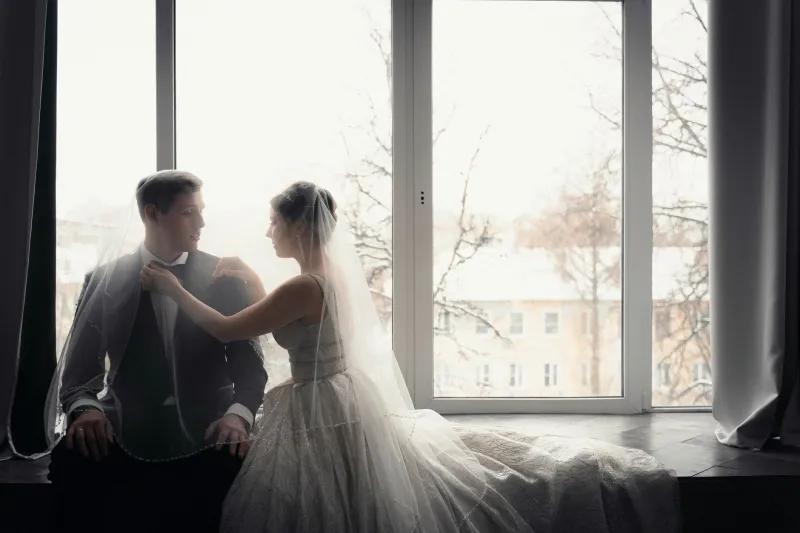
The House Is Still Being Restored: Shooting a Wedding Around Conservation Work
Photo: Lukacs., Public domain, via Wikimedia Commons
A historic house is never really finished. There is always a roof to mend, a window to reglaze, a ceiling to inspect or a wall that needs a specialist conservator rather than a tub of filler. That is why some couples arrive at a venue to find scaffolding on the west wing, tarpaulins over the orangery and a polite sign saying that the library is closed for essential works. It can feel like bad luck. It can also be one of the most interesting things about the wedding.
At Castle Photography, we have photographed weddings in houses while conservation work was underway, and the days that worked best were the ones where nobody pretended the building was something it was not. The scaffolding was not hidden. The dust sheets were not shameful. They were part of the story of a place that people care enough to repair. The trick is to photograph that honestly, safely and with a clear line between atmosphere and mess.
Why a building site can be a beautiful venue
There is something quietly romantic about a house in mid-repair. You can see the bones of it. Ladders, lime plaster, half-unwrapped columns and the smell of old timber all say that this building has a future. For couples who chose a historic venue because they love old things, that is not a distraction. It is evidence.
It also gives photographs a texture you cannot fake. Scaffolding makes strong graphic lines. Tarpaulins catch the light like enormous softboxes. A closed door with a conservation notice on it can be more intriguing than another formal drawing room. The trick is to use these elements with intention, not to let them creep into every frame by accident.
Read the site before you raise a camera
Before the wedding day, ask for a walk-round with the venue's events manager or house manager. Find out what is actually off-limits, what is merely inconvenient and what is dangerous. Scaffolding is not a playground. Some poles are load-bearing, some platforms are not for public access, and some areas will be strictly out of bounds for insurance reasons. Respect that. No photograph is worth a fall or a complaint from a conservation team.
Ask which rooms are closed, which routes are diverted and whether any work will be happening on the day. A house that is quiet during the ceremony may have contractors arriving at 7am the next morning. That is fine, as long as you know. Ask whether there will be noise, dust, fumes or power cuts. Ask whether the ceremony room has been affected. Ask what the venue wants you to do if a guest wanders towards a restricted area.
Scaffolding as a frame, not a problem
Scaffolding can look chaotic in a wide shot, so get close and use it deliberately. Shoot through the poles to frame the couple. Use a diagonal brace as a leading line. Photograph the house from below with the couple small in the frame and the structure rising above them. At dusk, scaffolding can become a silhouette against the sky, especially if the house is lit from within.
Be careful with light. Scaffolding casts hard shadows, and on a bright day the metal can bounce odd colours onto faces. Move the couple into a doorway or under a covered walkway where the light is softer. If the structure is ugly in colour, convert a few frames to black and white. A monochrome image often turns a building site into architecture.
Dust sheets and tarpaulins
Dust sheets are underrated. A white sheet draped over a piano, a chair or a doorway can look sculptural. It can also look like a removal van has crashed into the reception. The difference is framing. Use sheets as a simple backdrop for details, or as a soft white shape behind a couple in a dark room. Avoid making them the main subject unless the shot is clearly about the repair work.
Tarpaulins are trickier. They are often bright blue, green or translucent, and they flap in the wind. Use them as a colour accent in a wider shot, or shoot through translucent plastic for a soft, diffused look. Do not climb on them. Do not move them if they are protecting something from rain. If a tarpaulin is covering a roof, it is doing a job. Photograph it from a respectful distance and let it be part of the story.
Closed rooms and the limits of access
A closed room is not a challenge to be overcome. It is a boundary. If a room is shut for conservation, do not ask the couple to sneak in for a portrait. Do not prop the door open for a better angle. Do not move barriers. Historic houses are often privately owned or run by charities with tight budgets, and conservation work can be delicate. The best photographers are the ones who get invited back because they were easy to work with.
Instead, look for alternative spaces: a staircase, a corridor, a window seat, a covered courtyard, a marquee or a room that has been set aside for guests. Some of the best winter wedding photographs happen in small, unlikely spaces because the light is contained and the couple has nowhere to hide.
What to ask the venue before booking
If you are booking a historic house and you know work is planned, ask for a written summary of what will be affected. Ask whether the ceremony and reception rooms are guaranteed to be available. Ask what happens if the work overruns. Ask whether scaffolding will be removed before the wedding or remain in place. Ask whether the venue will provide alternative spaces if a room is closed. Ask about noise, access and parking for suppliers. Ask whether your photographer can visit before the day.
It is also fair to ask for a small concession if the house is going to look substantially different from the photographs you were shown. Most venues will be honest. Some will offer a reduced rate, an upgraded room or extra time on site. If they are evasive, that tells you something too.
A shot list for a house mid-repair
Keep it simple. Photograph the couple under scaffolding, framed by poles. Use a dust sheet as a backdrop for rings or flowers. Take a wide shot of the house with the repair work visible, because in 20 years it will be a historical detail in itself. Photograph the closed door, the ladder, the pot of lime plaster. Then put the camera down and enjoy the wedding. The repair work is not the whole story. It is just the part of the building's life that happened to overlap with yours. Photographed with care, it can be a generous, honest backdrop rather than a flaw.