When the House Is Still Open: Wedding Photos in a Working Historic Venue
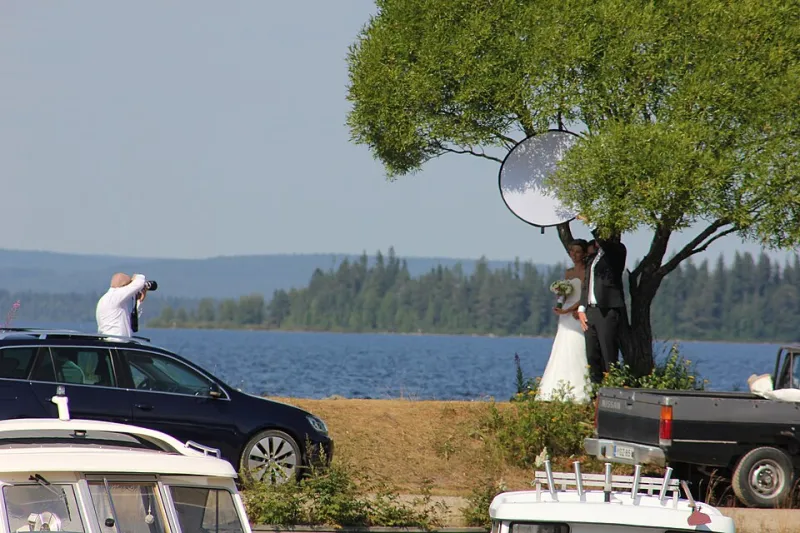
Photo: Kajaanifoto, CC BY-SA 4.0, via Wikimedia Commons
A working historic house does not stop being a visitor attraction because a couple has booked the orangery. On a Saturday in June, the tea room may still be serving scones at eleven, the volunteer on the stairs may still be explaining the ceiling to a family, and a coach party may still be filing past the very window you had earmarked for the first look. This is not a problem to be solved. It is a condition of the venue, and it can make the photographs more interesting if you plan for it.
The key is to stop chasing the fantasy of an empty house. You are not going to get a clean run at the Long Gallery at midday unless the venue has sold you exclusive access. What you can get is atmosphere, scale and a sense that the couple are part of a place that has a life beyond their wedding.
The reality of a house that opens at ten
Many historic venues in the UK operate a split day. The ceremony might be at two, but the house opens to the public at ten or eleven. Some National Trust and English Heritage properties have separate wedding routes; others, particularly smaller Historic Houses association members, simply keep the show on the road. Either way, the wedding timeline has to bend around the visitor timetable.
Ask the event manager for the public opening hours before you build the shot list. Ask where the rope lines will be, which rooms are closed for the wedding, and which routes the visitors will use. If the answer is that visitors will be in the same rooms as the couple at certain times, believe them and plan for it.
Timed access: build the day around the rope line
The most useful thing you can do is identify your windows of private access. A venue may give you the ceremony room for an hour before the guests arrive, or the garden for a short portrait session before the gates open. Those windows are gold. Use them for the images that absolutely need privacy: the vows, the register signing, the quiet portraits.
For everything else, work with the public rhythm. The house may be busiest between eleven and one, quieter after lunch, and empty again after four. If you can schedule the couple's portraits for the late afternoon, you may get the state rooms to yourselves without paying for exclusivity. If not, use the busy periods for documentary photographs and the quiet periods for the formal ones.
A realistic timeline for a public day
This is not a rigid schedule, but it is the shape that tends to work when the house stays open.
- 08:00 to 09:00: supplier access and room set-up. Photograph details before the public arrives: flowers, table settings, the ceremony room in its quiet state.
- 09:00 to 10:00: couple preparation in a private room or cottage. Keep curtains open for soft light and keep the room tidy enough to work in.
- 10:00 to 10:30: first look or couple portraits in a private garden or closed room. This is often the best window of the day.
- 10:30 to 11:30: visitors arrive. Switch to documentary mode. Photograph guests arriving, the couple greeting people, the house coming to life around them.
- 11:30 to 12:15: ceremony. This should be in a private or semi-private space. If visitors can watch from a gallery, embrace it; if not, keep your movements discreet.
- 12:15 to 13:00: drinks reception. Use the rope line as a frame rather than an obstacle. Photograph the couple against the crowd, not in spite of it.
- 13:00 to 14:00: timed portrait slot. Fifteen minutes in a quiet corridor or garden is worth more than an hour of waiting for an empty room.
- 14:00 to 16:00: lunch and speeches. The house may be at its busiest. This is a good time for details, room shots and guest candids.
- 16:00 onwards: public rooms begin to clear. Use the last hour of daylight for the grander portraits if the couple want them.
Posing without pretending the visitors have vanished
The worst mistake is to pose a couple in the middle of a public room and then try to Photoshop the visitors out of the background. It rarely looks convincing, and it wastes time. Instead, compose with the public in mind.
Use a longer lens to compress the scene and throw the visitors softly out of focus. Frame through doorways so the couple are the clear subject and the gallery beyond becomes texture. Put the couple on the inside of a rope line and shoot from the public side; the rope becomes a leading line rather than a nuisance. If a visitor wanders into the frame, wait two seconds. They usually move. If they do not, use them. A blurred figure in a historic corridor can add exactly the sense of life that a sterile empty room lacks.
For the formal portraits, choose angles that crop out the public route. A corner, a window reveal, a doorway or a garden bench can all give the illusion of privacy without telling a lie. Keep your instructions simple and quiet. The couple do not need to know that a coach party is approaching; they just need to know where to look and how to stand.
The diplomacy bit
Curious visitors are part of the deal. Some will congratulate the couple. Some will take a photograph from a respectful distance. Some will ask a volunteer what is going on. None of this needs to derail the day if you are gracious about it.
Do not block walkways with light stands. Do not ask visitors to move unless the venue has given you permission to do so. Do not photograph identifiable children without checking with their adults. If a room is roped off, stay behind the rope. And if a visitor apologises for being in the shot, tell them not to worry. They are in a historic house on a Saturday; they have as much right to be there as the wedding party.
The venue staff are your allies here. They know the rhythms of the house, the busy corners and the quiet ones. A quiet word with the housekeeper or event manager at the start of the day can save you an hour of guessing later.
What to ask the venue before you book
Ask how public access works on a wedding day. Ask whether the ceremony room is closed to visitors, whether the gardens are private, and whether there is a designated wedding route. Ask what happens if a visitor walks into a portrait session, and whether the venue has a policy on photography in the state rooms. Ask about timing: when the house opens, when it closes, and when the last visitor leaves. And ask whether there is any flexibility to close a single room for ten minutes. Some venues can, some cannot. Better to know before the couple falls in love with the staircase.
A working historic house will never give you a completely blank canvas. What it gives you instead is a living backdrop: volunteers, visitors, the smell of tea, the sound of feet on old boards. Photograph that honestly, and the wedding will look like it happened in a real place, because it did.