Scuffed Thresholds and Window Nooks: Five Historic House Details That Tell the Story
Photo: Minnesota Historical Society Heritage Preservation Department, CC BY-SA 2.0, via Wikimedia Commons
The grand staircase is the obvious shot. It is ceremonial, symmetrical and built to impress. But after a few years of photographing weddings in old houses, the frames that linger are rarely the ones with the widest lens. They are the scuffed threshold, the window seat with a dent in the cushion, the door that does not quite match its neighbour. These are the details that make a historic house feel lived in rather than merely hired.
This is not a case for ignoring the staircase. Use it, by all means. But give yourself twenty minutes for the smaller things too. They often tell a couple's story with less effort and more truth.
1. The worn threshold
Look down. The dip in the stone at a doorway has been made by generations of feet, and on a wedding day it gets one more pair. A threshold is a natural frame for a quiet entrance, a first step into the reception room, or a moment of pause before the couple goes back to the party.
Shot ideas: a low angle as the couple crosses hand in hand; a close-up of the bride's shoes and the groom's heel on the worn stone; a wider frame from inside the room as they appear in the doorway. If the threshold is particularly beautiful, ask them to stand just short of it and look at each other rather than at the camera.
Lighting note: doorways are usually brighter than the room behind them, so expose for the couple's faces and let the interior fall into shadow. A fast prime lens helps. Avoid direct flash on old stone and oak; if you need fill, bounce a small off-camera flash off a pale wall well away from the surface.
2. The window seat
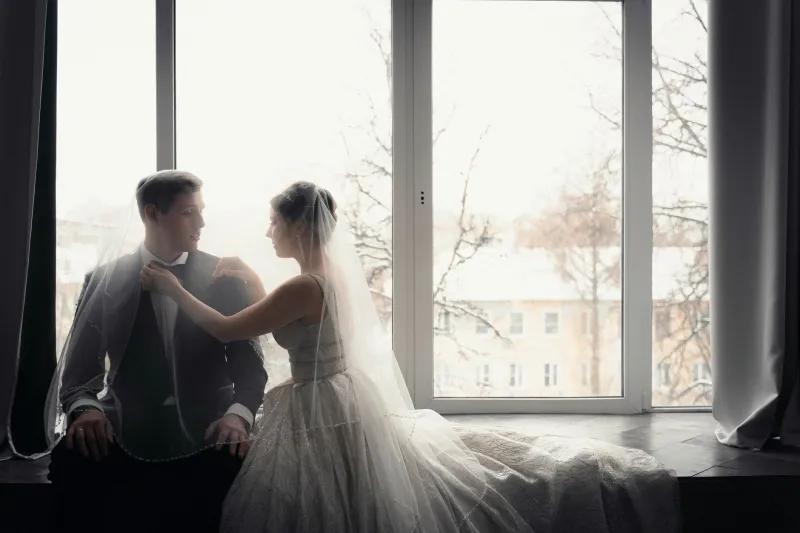
Window seats are made for portraits. They give a couple somewhere to perch, a natural reason to sit close, and a soft light source right beside them. They also show scale: the thickness of the wall, the depth of the reveal, the way the garden sits outside.
Shot ideas: one seated portrait with the couple angled towards each other; a close frame of hands resting on the sill; a wider shot from across the room with the window acting as a bright rectangle in a dark interior. If the seat is fragile, do not sit on it. Use it as a backdrop and keep the couple standing.
Lighting note: the window is your softbox. Turn off any overhead lights that are not needed, because mixed colour temperature is the enemy of old interiors. Use a reflector or a small bounce to lift the side of the face away from the window. In very dark rooms, a continuous LED panel at low power can add a little shape without flattening the atmosphere.
3. Linenfold panelling
Linenfold panelling is a gift for close-ups. The carved folds catch light and create texture that looks wonderful in black and white. It also places the couple in a room that has been touched by centuries of hands, which is exactly the point of choosing a historic venue.
Shot ideas: a tight frame of the couple's hands against the panel, rings visible but not dominant; a profile portrait with the panelling filling the background; a detail of the carving beside a bouquet. Side light is best because it rakes across the folds.
Lighting note: do not blast panelling with direct flash. It kills the texture and can be unkind to old timber. Use window light or a small continuous light held at a low angle. If the room is very dark, raise the ISO rather than overcooking the flash. A little grain is a fair trade for atmosphere.
4. The service corridor
Back-of-house spaces are often the most interesting rooms in a working historic house. Plain walls, bells, uneven floors, a noticeboard, a narrow stair. They explain how the house actually functioned, and they give a couple a quiet place to breathe away from the party.
Shot ideas: a documentary frame of the couple walking away down the corridor; a close-up of an old bell board or a worn handrail; a portrait in a plain doorway with the clutter of real life around the edges. These images sit beautifully between the formal portraits and the dance floor.
Lighting note: service corridors are usually gloomy, so pack a fast lens and be prepared for ISO 3200 or higher. If the ceiling is low and pale, a bounced flash can work wonders. Check with the venue first, and keep cables and bags out of walkways.
5. Mismatched doors
A house that has grown over centuries rarely has matching doors. One is tall and panelled, another is short and painted, another has a brass knob polished by use. That mismatch is a story in itself, and it makes for lovely, graphic photographs.
Shot ideas: the couple framed in one doorway and looking through to another; a detail of two different handles side by side; a wide shot showing a run of doors along a corridor. If a door is closed, do not open it without permission. The best frames are often the ones you can make with the doors as they are.
Lighting note: use the light coming through door glass or from the room beyond. Silhouettes can be very effective here. If you need detail in the couple's faces, expose for them and let the doorway burn out slightly; it reads as light rather than error.
Lighting notes for rooms that eat light
Historic houses are dark for good reason: sunlight fades textiles, and conservation comes first. Work with that rather than fighting it. Carry a fast 35mm or 50mm lens, a small reflector and a modest off-camera flash you can bounce. Avoid direct flash on paintings, textiles, gilded surfaces and polished furniture. If in doubt, ask the housekeeper or event manager what is allowed.
A short etiquette guide for fragile surfaces
You do not need to turn the wedding day into a heritage lecture. A few quiet habits are enough. Do not sit on antique chairs unless the venue says you can. Do not lean on panelling or place drinks on polished tables. Keep gear off the floor in state rooms. Never move objects for a better composition. Respect rope lines, even when they are inconvenient. And brief the couple once, gently, before they go into the historic rooms: hands off, feet careful, no flash on the fabrics. Most couples are happy to comply when they understand why.
The grand staircase will always get its frame. But the threshold, the window seat and the odd little door will often get the photograph that feels most like them.